What Can The Oupes Guardian 6000 Run With 6000 Watts Of Power
Six thousand watts sounds substantial, but wattage alone does not reveal how long your appliances will stay powered. Here is what those numbers mean at home.
By admin
·August 26 03
All featured products are selected by our editors and may include affiliate links. If you purchase through these links, we may earn a commission.
A blackout immediately translates electrical standards into practical concerns. Can the fridge stay cold, can the water pump run, and can central air still work? The Oupes Guardian 6000 V2 combines 6000W of 240V output with 4608Wh of battery capacity, but those figures describe different abilities.
Why 6000 Watts Does Not Tell You How Long Your Appliances Will Run
A 6000W rating describes how much power the unit can supply, while 4608Wh describes stored energy. Think of wattage as the size of the workload the system can handle and watt hours as the amount of energy available to keep that workload going.
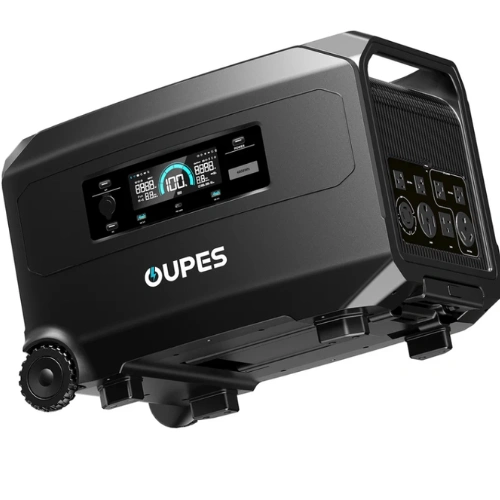
That differential applies with the Oupes Guardian 6000 because a high output rating can handle demanding equipment without producing endless runtime. A 1500W heater, for example, uses stored energy significantly faster than a router consuming a fraction of that amount.
How Output Power And Battery Capacity Shape Real Performance
Oupes advertises it as 6000W output at 240V and 3600W at 120V. It has a 7200W boost mode. It provides the system with enough output for all of the basic electronics, to central air conditioning, dryers and water pumps as long as the associated loads are within the proper limitations.
The capacity calculation has to be different. 4608Wh / total wattage of everything running = estimated theoretical run time in hours Real world usable runtime will be reduced due to inverter losses, temperature, appliance cycling and changing loads.
Which Household Appliances Can The Oupes Guardian 6000 Handle
For ordinary essentials, 6000W provides considerable headroom. Refrigerators, lights, internet equipment, televisions and many kitchen appliances can operate without approaching the maximum output individually. The more important calculation becomes their combined demand and how frequently each appliance runs.
A helpful method is to divide equipment into continuous loads and cycling loads. A refrigerator compressor turns on and off. A router might be running all the time. Simply adding every appliance label at full wattage can consequently give a deceptive picture of daily energy use.
Powering Central Air Dryers Pumps And Other 240V Equipment
The 240V side makes this Portable Power Station more relevant for serious home backup. Oupes specifically lists central AC systems, dryers and water pumps among supported applications. Outlets include connections intended for 240V equipment, RV use and home electrical integration.
But compatibility of an appliance does not guarantee it’s efficient to use it for hours. A 4.6kWh battery can be drained quickly on high demand devices. If the power is down for a long time you may well need to keep a fridge and key electronics running more than you need to run many large appliances at once.
Running Several Appliances At The Same Time
The Guardian 6000 V2 can connect up to 12 devices, but outlet count should never be confused with available output. Every active appliance contributes to the total load. A microwave, heater, and pump operating together can create a very different demand on the lights, phones, and a router.
This is where planning beats guesswork. Look at the ratings for each appliance, figure out which devices can be started simultaneously, and leave some sensible output headroom. People with a 6000 Watt generator-style system for home backup will generally get more runtime by scheduling large loads instead of running them all at once.
How To Estimate Runtime Before Connecting Your Appliances
You start with the watts of the device, and for how long you think it will be on. 4608 Wh/ 1000 W constant load = 4.6 hours theoretical before system losses. A 500W continuous load yields nearly twice that theoretical time.
Houses are something else again. Refrigerators cycle on and off. Pumps cycle on and off as needed. Demand for heating or cooling equipment varies over the course of the day. If you want to have a backup plan, consumption over several hours is considerably better than the number displayed on the appliance label.
A Reddit thread points out why this distinction is confusing. A Guardian 6000 owner evaluating 800W to 1000W of house load is looking for substantially longer run time. Answers distinguished between watts and watt-hours. Suggestions included shedding nonessential loads or boosting capacity for longer outages.
Why Starting Power Matters For Motors And Compressors
Some appliances briefly demand more power when their motors start. Refrigerators, pumps, compressors and air conditioning equipment are common examples. Their normal running wattage therefore tells only part of the story.
Before you connect one, check its typical usage and its startup requirements. Oupes says the Guardian 6000 V2 does include a 7200W boost mode, but appliance specs still matter. A system must be sized to handle its initial load, plus whatever else is already running.
When A 6000 Watt Generator Style Power Station Makes Sense At Home
Short outages are where the base 4608Wh battery can be especially practical. Instead of trying to recreate normal household consumption, you can prioritize refrigeration, communications, selected lighting and other essentials. The 20 millisecond EPS switchover also supports equipment that benefits from rapid backup when grid power disappears.
For prolonged interruptions, it is more vital to budget energy than to have maximum productivity. Oupes has an inlet box and transfer switch for home integration so you may provide back up power to specific circuits in your home. Electrical panel work must be properly set up such that it is safely isolated from the utility power.
How Solar Charging Can Extend Available Backup Power
Solar turns runtime into an energy management concern, not just a countdown. Guardian 6000 V2 has dual high-voltage MPPT inputs, which can handle up to 3600W of solar input, says Oupes. Solar output is high during the day, and stored capacity can provide for demand later in the day.
People researching the Best Portable Solar Power Station should pay attention to that relationship between consumption and replenishment. A large solar input specification cannot guarantee a particular daily yield because panel positioning, weather, sunlight hours and system conditions affect real production.
FAQs
Can The Oupes Guardian 6000 Run Central Air Conditioning?
Central AC is meant for purposes like these; Oupes identifies 240V as one. Real compatibility depends on the operating demand and startup needs of the air conditioning system. So it is still necessary to check out the exact unit specification before connecting it.
Can The Oupes Guardian 6000 Power A Whole Home?
It can connect to household circuits through appropriate transfer equipment and supply substantial 120V and 240V loads. Whole home backup still requires load management because 6000W output and 4608Wh base capacity place separate limits on simultaneous demand and runtime.
Can You Add More Battery Capacity Later?
Yes. OUPES states that Guardian 6000 V2 works with G5 expansion batteries and can reach 41.4kWh of total capacity. B2 and B5 batteries are not listed as compatible with this model.
OUPES Guardian 6000 V2 makes the most sense when its 6000W output is treated as available power and its 4608Wh battery as a separate energy budget. Planning loads around both figures can make backup power last longer, especially when extra battery capacity or solar charging is available.
People looking to lower the cost should also check the latest OUPES Promo Codes for any available discounts.
Follow FreshFads for more practical home and tech guides.